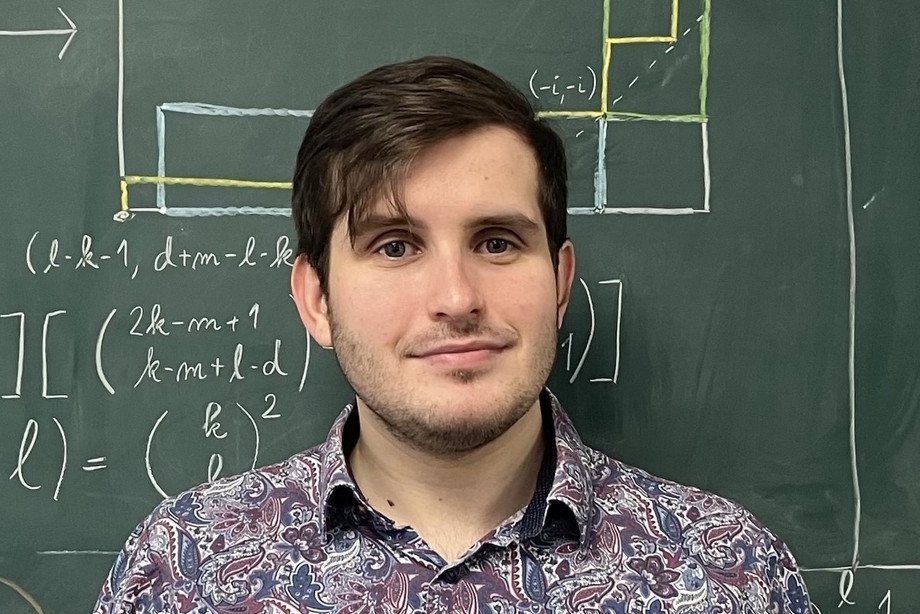
Dr Jan Petr has been awarded a prestigious two-year Humboldt Research Fellowship to pursue research in pure mathematics at the University of Passau, beginning in October 2026. His research interests lie at the intersection of discrete mathematics and algebra, where he seeks to combine techniques from both fields to gain deeper insights into fundamental mathematical structures, including graphs and Latin squares.
Imagine a square array whose individual cells are filled with symbols in such a way that every symbol appears exactly once in each row and each column. These objects, known as Latin squares, have fascinated mathematicians since at least the 18th century. They also have practical applications, with connections to fields such as experimental design, scheduling and error-correcting codes.
One of the central questions in the theory of Latin squares goes back to the work of Leonhard Euler and concerns so-called transversals. A transversal is a collection of cells in a Latin square such that no two cells lie in the same row, column or contain the same symbol. In a completed 9×9 Sudoku grid, for example, one can always find a transversal of size 9—the largest possible size for a square of this order.
But finding such transversals is far from easy. In fact, there are Latin squares of order 8 that contain no transversal of size 8 at all. This phenomenon is at the heart of the famous Ryser–Brualdi–Stein conjecture, which predicts that every Latin square of odd order has a transversal of full size, while every Latin square of even order has a transversal of size at least one less than the order.
"Transversals are notoriously difficult to find. Even in the 9×9 case, there are many possible ways to select nine cells, yet only a tiny fraction of these choices form a transversal. As the order of the Latin square increases, the number of possibilities grows super-exponentially, making the search increasingly challenging. It is, quite literally, like looking for a needle in a haystack," explains Professor Stefan Glock, who hosts the research project at the University of Passau.
A major breakthrough came just three years ago. More than 50 years after the conjecture was first formulated, mathematician Richard Montgomery proved that every sufficiently large Latin square contains a transversal that misses at most one row, one column and one symbol. His proof brings together ideas from algebra and discrete mathematics, including a powerful technique known as the absorption method.
Dr Jan Petr’s plan for the following two years consists of researching a handful of questions, two of which are connected to Latin squares. Montgomery’s result, synthesising ideas from various areas of mathematics, serves as an inspiration. In his words: "A promising direction for tackling some of the problems I intend to focus on in the coming years is the absorption method. I feel grateful and lucky to be spending the next two years in Passau in the group of Professor Stefan Glock who is one of the leading experts on it!"
Another direction in Dr Jan Petr’s research plan relates to graphs and their spectra. Graphs — vertices connected by edges — are one of the most basic objects in discrete mathematics. Among countless applications, they serve as models of networks, be those social relations, roads between cities or connections between neurons. The spectrum of a graph is simply a collection of numbers. They are defined algebraically, namely as the eigenvalues of the graph’s adjacency matrix. Graphs are not the only objects whose spectra can be studied. For example, an analogous spectrum can be assigned to domains in the plane. "Can one hear a shape of a drum?" is now a widely known quippy question asking how much one can infer about the domain ("membrane of a drum") from its spectrum ("sound"). A play on this question, "Can one hear the shape of a graph?", is the direction Dr Petr is interested in.
About the researcher
Before beginning his Humboldt Research Fellowship, Dr Jan Petr had already been a postdoctoral researcher in the Discrete Mathematics group in Passau since June 2025. He received his PhD from the University of Cambridge, where he was supervised by Professor Béla Bollobás. Dr Jan Petr’s publications span multiple topics in discrete mathematics, particularly within graph theory. Some of his more recent work, and especially his upcoming manuscript with Dr Pavel Turek about Coxeter groups, move closer to algebraic topics. In the winter semester 2026/27, he will also teach the course Algebraic Combinatorics, featuring some highlights of the interplay between discrete mathematics and algebra.
| Principal Investigator(s) at the University | Prof. Dr. Stefan Glock (Professur für Diskrete Mathematik) |
|---|---|
| Project period | 01.10.2026 - 30.09.2028 |
| Source of funding |

Alexander von Humboldt-Stiftung
|
| Themenfelder | Mathematik |